
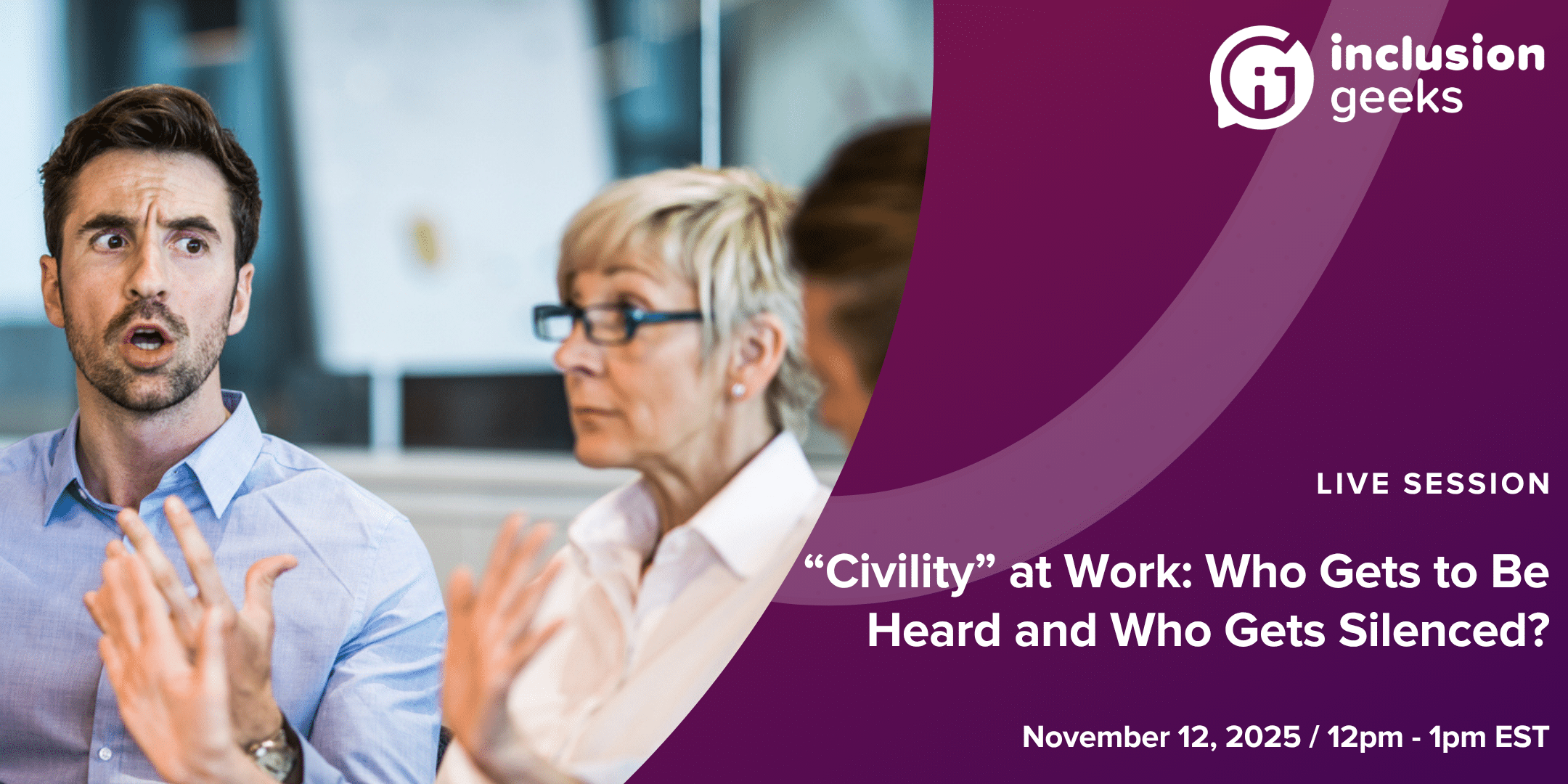
Felicia Jadczak led our November session focusing on a word that shows up in trainings, handbooks, and leadership communications. She tackled the concept of “civility”, and addressed the harder question underneath it, which is who gets to decide what “civil” looks like.
How Is Civility Usually Defined at Work?
Most of us were taught that civility means being polite, assuming good intentions, avoiding conflict, keeping it “professional,” never raising your voice, and not rocking the boat. As backlash against DEI work has grown, civility has increasingly stepped in to fill the space those conversations used to occupy, which makes it worth examining closely.
Who Gets to Define Civility and Professionalism?
The people who define civility are usually the people in charge, and in the U.S. those roles have historically been held by people from dominant groups. As a result, norms around respect and professionalism often reflect a white, male, Western standard, a pattern researchers have traced in how professionalism standards privilege white, Western norms around dress, speech, and work style. Felicia called this the “spoonful of sugar” problem, where respect becomes code for compliance and anyone who disagrees risks being labeled a troublemaker.
Which Behaviors Get Labeled “Uncivil,” and for Whom
Raising your voice, showing emotion, being direct, challenging authority, and giving unsoftened feedback are all commonly labeled uncivil. Felicia shared that during her years in tech, she received countless performance reviews calling her “too aggressive” when she was simply direct. These labels fall hardest on marginalized groups. Women and nonbinary people get called too emotional, Black and brown employees too aggressive, neurodivergent people not team players, and queer folks unprofessional. When the bar for professionalism is built on dominant norms, people outside those norms are far more likely to be judged, dismissed, or punished.
How Civility Becomes a Shield
Civility becomes a shield when it’s used for tone policing, avoiding hard conversations, or suppressing dissent, and when it protects the comfort of people in power over everyone else. Felicia’s question for any workplace is a simple one. Are we promoting civility, or are we promoting silence?
How Power Shapes Who Gets Heard
Power shapes who feels safe speaking up and how their words are received. Felicia described co-facilitating with people who hold different identities and watching the exact same words be received completely differently. The same idea can sound strategic coming from a senior white man and disruptive coming from a younger woman of color, and the same emotion can read as passion from one person and an outburst from another. Coping mechanisms like code switching and self-censorship are common as a result, and managers can unconsciously favor people whose communication style mirrors their own.
What Does True Civility Look Like?
True civility starts with an equity lens and four practices.
- Make space for discomfort. Felicia had attendees clasp their hands, then switch which thumb was on top. It feels awkward at first, but with repetition it becomes natural, and discomfort at work often works the same way.
- Listen across difference. Your lived experience and someone else’s can both be true, even when they don’t match.
- Call in and call out with care. Consider context and relationships, and protect the dignity of everyone, not only the comfort of a few.
- Confront harm instead of keeping the peace.
Felicia also shared simple reframes. Instead of “You’re being way too emotional,” try “It’s okay to feel strongly, this really matters.” Instead of “Let’s not make this about race,” try “I want to understand your perspective. Can you tell me more?” And to make it stick, remember the three R’s of civility, which are to recognize who is being prioritized and dismissed, reframe from tone to content, and respond in ways that prioritize the truth.
Why Accountability is Critical
Accountability means owning impact, not only intent. Felicia shared a favorite comic of a broken egg where “I meant well” and “That was not my intent” are crossed out, and “I broke the egg” gets the checkmark. For organizations, that means shared definitions of civility, policies that clearly condemn harassment and discrimination, managers equipped for difficult conversations, and a culture of feedback at every level.
Key Takeaways
- Traditional definitions of civility often reflect dominant cultural norms set by the people in charge
- Labels like “too emotional” and “unprofessional” fall disproportionately on marginalized groups
- Civility can become a shield for tone policing and suppressing dissent
- Power shapes how the same words are received
- True civility makes space for discomfort, listens across difference, and confronts harm
- Use the three R’s to recognize, reframe, and respond
- Accountability means owning impact, not only intent